7 Thrilling Escape Room Theme Ideas for Home Setup (That Won’t Break the Bank)
You don’t actually need to spend hundreds of dollars locking your friends in a commercial gaming facility just to watch them argue over a four-digit padlock.
Setting one up right in your living room or basement is completely doable and honestly? Way more personal.
The secret to pulling it off isn’t having high-tech electronics or laser grids. It all comes down to picking a clear, immersive storyline. Once you lock in a solid concept, the puzzles sort of build themselves around whatever odd junk you already have lying around in drawers. If you’re looking for creative escape room theme ideas for home setup projects, here is a breakdown of realistic themes, clever puzzle mechanics, and simple setup tips to turn your house into an unforgettable game night adventure.
Why Setting Up a Home Escape Room Works So Well
Let’s be real for a second. Commercial escape rooms are great, but they are scripted for strangers. At home, you know exactly what makes your friends laugh, what kind of puzzles frustrate your siblings, and how far you can push the spooky factor before someone refuses to enter the hallway.
Plus, you can reuse standard household items:
- Old combination bike locks.
- Unused luggage trunks or shoeboxes.
- Scented candles and mood lighting.
- A basic smartphone timer with a moody Spotify playlist running in the background.
It turns an ordinary Friday night into something people will actually talk about months later.
7 Immersive Escape Room Theme Ideas for Home Setup
Here are seven tried-and-tested theme concepts that you can adapt to almost any room size.
1. The Mad Scientist’s Quarantine Protocol
- Best Room: Kitchen or Garage.
- The Story: A lab experiment went wildly wrong. The ventilation system has locked down, and the antidote formula is scattered across coded lab notes.
- Key Props: Measuring beakers, food coloring in glass jars, rubber gloves, clipboard checklists, and safety goggles.
- How It Plays: Use colored liquids with measurement lines where matching specific volumes reveals a number code for a lockbox.
2. The Museum Heist: Midnight at the Gallery
- Best Room: Living Room or Dining Room.
- The Story: You and your crew have 60 minutes to swipe a legendary artifact from a private collector’s study before the automated security reboots.
- Key Props: Red yarn taped across the room (as fake laser beams), framed art with hidden symbols, velvet jewelry boxes.
- How It Plays: Players must duck under yarn lasers to reach clues. Flipping a picture frame might reveal a safe code written in reverse.
3. The 1970s Time Machine Glitch
- Best Room: Any bedroom or retro-styled lounge.
- The Story: A time machine malfunction traps players in a funky past decade. To return to the present day, they must repair the temporal clock.
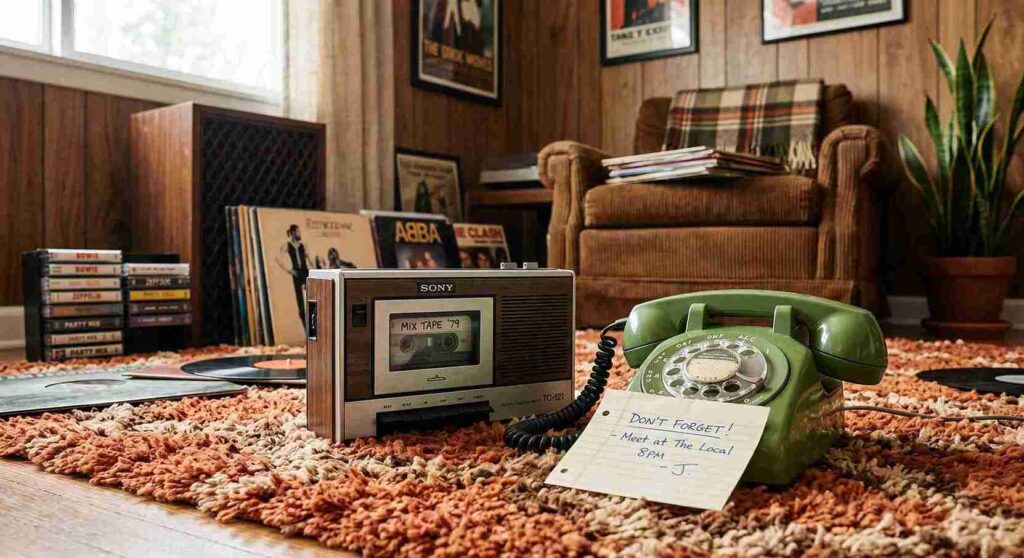
- Key Props: Rotary phones, cassette tapes, vinyl record sleeves, and vintage prints.
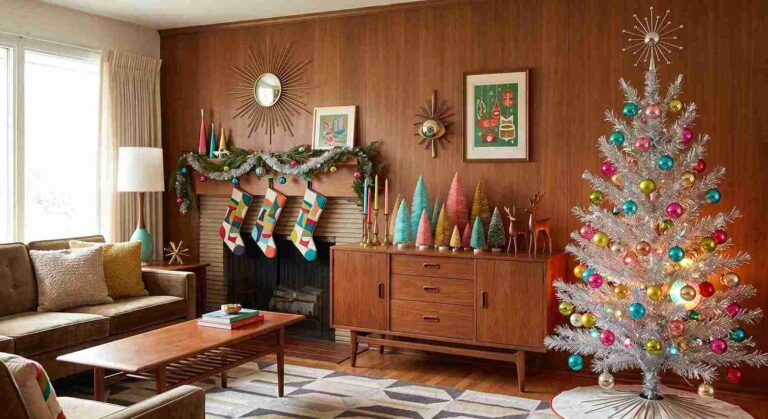
- Decor Tip: If your room already features groovy patterns or earthy tones from vintage styling, you can pull elements right from classic 70s home decor to instantly build atmosphere without spending a dime on extra props.
- How It Plays: Hide clues inside vinyl album tracklists, or write a phone number clue that players must dial on an old rotary phone.
4. Haunted Manor: The Cursed Will
- Best Room: Basement or a dimly lit bedroom.
- The Story: An eccentric relative passed away, leaving their fortune locked behind paranormal riddles.
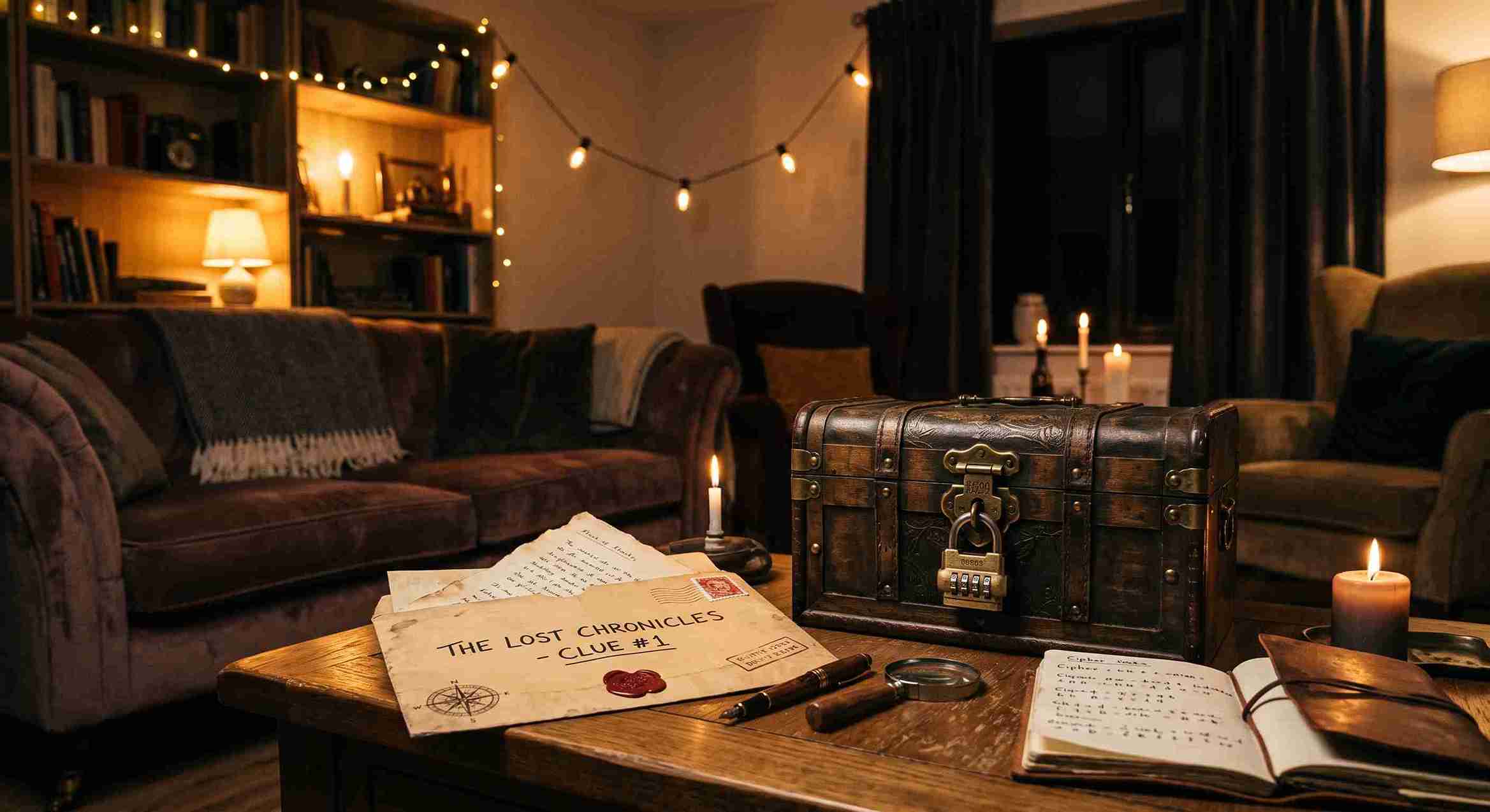
- Key Props: Old hardback books, battery-operated flickering candles, dusty trunks, antique keys.
- How It Plays: Blackout curtains are a must here. Players use flashlights to find hidden messages penciled lightly on the edge of book pages.
5. High-Stakes Spy Safehouse
- Best Room: Home Office or Study.
- The Story: An undercover operative vanished, leaving behind an encrypted USB drive that will self-destruct in one hour.
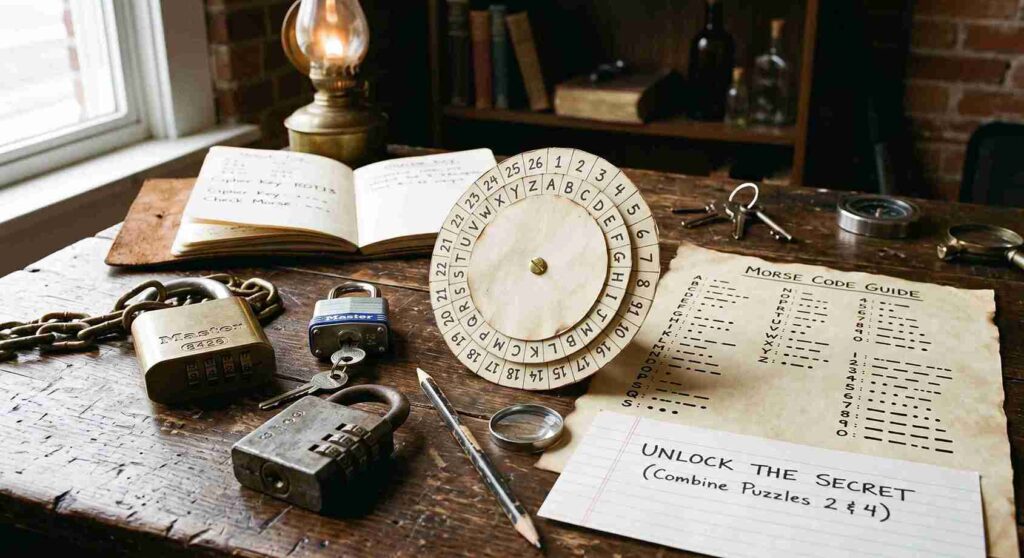
- Key Props: Briefcases, shredded paperwork, cipher wheels, world maps pinned to corkboards.
- How It Plays: A Caesar shift cipher hidden within a fictional newspaper clipping reveals the briefcase combination.
6. The Pharaoh’s Tomb Expedition
- Best Room: Any space with warm, dimmed yellow lighting.
- The Story: Trapped inside an ancient burial chamber! Players have to align sacred relics before the oxygen runs out.
- Key Props: Sand trays, printed hieroglyphic sheets, cardboard pyramid boxes, golden trinkets.
- How It Plays: Players dig through a sand tray to find stone tokens that spell out a riddle answer.
7. Space Station Oxygen Failure
- Best Room: Hallway or clean modern spare room.
- The Story: The primary life support offline alarm is blaring. The crew needs to restore the power cells manually.
- Key Props: Silver foil, blue LED strip lights, digital kitchen timers, puzzle switches.
- How It Plays: Logic-grid puzzles where wires (colored cords) must be plugged into correct slots to unlock the emergency exit code.
Comparing Home Escape Room Themes
| Theme | Best Room | Difficulty to Setup | Key Prop Requirement |
| Mad Scientist | Kitchen / Garage | Medium | Beakers, colored liquids, safety gear |
| Museum Heist | Living Room | Easy | Red yarn, small paintings, locked boxes |
| 1970s Time Glitch | Lounge / Bedroom | Easy | Cassettes, vintage books, retro styling |
| Haunted Manor | Basement | Medium | Flickering candles, old trunks, locks |
| Spy Safehouse | Home Office | Easy | Folders, cipher sheets, locked briefcase |
| Pharaoh’s Tomb | Spare Room | Hard | Sand, hieroglyphics, relic props |
| Space Station | Modern Hallway | Hard | LED lighting, technical circuit sheets |
Practical DIY Clues & Puzzle Mechanics
You don’t need complicated tech. Some of the most satisfying escape room puzzles use standard analog tricks:
- The Book Cipher: Tell players to go to “Book Title, Page 34, Line 4, Word 2.” It feels like authentic detective work.
- Cut-Out Overlay Paper: Give players a normal-looking letter. Later, they find a sheet with random cut-out square windows. When placed on top of the letter, only specific letters show through, revealing the secret word.
- The Blacklight / UV Pen Trick: Write hidden codes on baseboards or picture frames with invisible ink. Place the UV flashlight inside an earlier lockbox.
- Directional Clues: Use a poem with directional words highlighted (North, Left, Up, Right) to open a directional padlock or guide players to a hiding spot behind a curtain.
- Mirror Writing: Write a password backward on an index card. Players will naturally realize they have to hold it up to a bathroom mirror to read it.
Step-by-Step Guide to Hosting Your DIY Game
Planning ahead saves you from game-day chaos. Follow this straightforward flow:
- Establish the Flow: Decide if your game is linear (Puzzle A leads to Puzzle B, which leads to Puzzle C) or open (players find multiple clues at once and solve them in any order). Linear is far easier to manage for beginners.
- Set the Scene with Sound: Background audio does 70% of the heavy lifting. Search for “dungeon ambient sounds” or “ticking clock suspense music” on your smart speaker.
- Establish Clear Boundaries: Put sticky notes or blue painter’s tape on doors or drawers that are off-limits (like your medicine cabinet or personal files).
- Be the Game Master: Sit in the corner with a notebook or stay in the next room. Give them up to 3 hint cards when they get stuck so the momentum doesn’t hit a dead end.
And don’t worry if things go slightly off track. If a lock gets stuck or someone guesses a code by accident, just laugh it off and keep the timer running.
Frequently Asked Questions
How long does a home escape room usually take?
Most DIY escape rooms are designed for 45 to 60 minutes. Around 5 to 7 well-thought-out puzzles are usually plenty for a small group of 3 to 6 people.
How much does it cost to set up an escape room at home?
It can cost virtually nothing if you use riddles, paper ciphers, and hidden items. If you choose to buy a couple of 3-digit padlocks, a lockable cash box, and a cheap UV pen, you can pull off a great setup for under $20 to $30.
What are the best escape room theme ideas for home setup beginners?
The Museum Heist or Spy Safehouse themes are the easiest to start with. They naturally fit standard living room furniture, use basic stationery props, and don’t require heavy room alterations.
Can I build an escape room without buying physical locks?
Yes! You can use digital password locks on a phone/laptop, substitution word puzzles, or hide clue envelopes that say “Do not open until you solve the kitchen riddle.”
Final Thoughts
Building your own DIY mystery doesn’t require a Hollywood budget. Pick a concept, gather a couple of locks, dim the lights, and let your creativity run the show. With the right mix of escape room theme ideas for home setup, your living room is about to become the ultimate weekend hangout spot.